Ownership.
Debiasing. AI.
Twenty-five years of peer-reviewed research — how people think about what they own, reducing biases that skew high-stakes decisions, and why people resist new technologies they shouldn't.
Thinkers50 Radar Class 2026 · JCR Best Article ·Wegner Theoretical Innovation Prize
Harvard · Stanford · Wharton · MIT · Kellogg · Yale · Columbia · LBS · INSEAD
Merck · Leidos · IARPA · Marketing Science Institute · Harvard Medical School · Wall Street Journal
Selected Talks
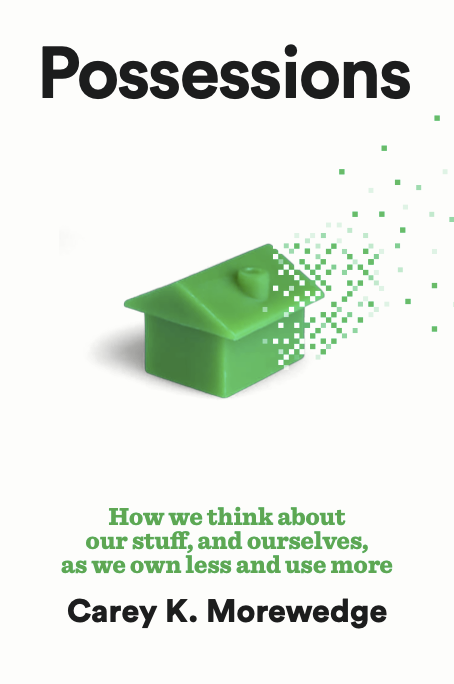
Possessions: The Future of Ownership in an Age of Access
Ownership shapes identity, signals belonging, and distorts how we value what we have. As consumption shifts from ownership to access, psychological attachments are changing in ways that reshape customer loyalty, economic value, and our sense of self.
Based on research published in the Journal of Marketing, Journal of Consumer Research, and a forthcoming book from Harvard Business Review Press.
Forthcoming book · Publishing January 19, 2027 · Harvard Business Review Press · Pre-order on Amazon or Porchlight
Make Better Decisions: Reduce Cognitive Bias
Confirmation bias and other anomalies affect even expert decision-makers. Carey's IARPA-funded research with Leidos and Creative Technologies Incorporated produced one of the few debiasing interventions shown to work in the real world. This talk introduces cognitive biases prevalent among expert analysts and evidence-based strategies for organizations seeking to make better judgments.
Research funded by IARPA; published in Harvard Business Review, Psychological Science, Organizational Behavior and Human Decision Processes, and Management Science
Trusting and Using AI
People resist algorithmic recommendations even when algorithms outperform human judgment. This talk explains why algorithm aversion and appreciation arise and how organizations can design AI systems that people actually trust and use.
Research published in Proceedings of the National Academy of Sciences, Nature Human Behavior, Journal of Consumer Research (2023 best paper), Journal of the Association for Consumer Research
Why Consumers Don't Treat Money Rationally
People don't treat money as money — they track where it came from, what it's "for," and whether a transaction feels like a gain or a loss. These mental distortions are predictable, systematic, and consequential. Drawing on prospect theory and mental accounting research, this talk explains the psychology behind irrational financial decisions and provides leaders with a practical framework for structuring costs, prices, and incentives in ways that align with, rather than run counter to, consumer psychology.
Research published in Management Science, Trends in Cognitive Sciences, Journal of Consumer Research, Journal of the European Economic Association, and Journal of Consumer Psychology
“Carey gave an engaging and thought-provoking talk on financial decision-making that was directly relevant to the challenges our group faces. His ideas sparked a strong discussion, and I’d recommend him to organizations looking for practical, evidence-based insights into consumer choices.”
—JIM BACON, BOARD MEMBER, HOSPITALITY INSURANCE GROUP
Consulting & Advising
Carey takes on a small number of consulting and advising engagements each year — working with organizations to design behavioral interventions, interpret research findings, and apply decision science to high-stakes challenges.
His IARPA-funded work with the U.S. intelligence community produced a debiasing intervention shown to improve the judgment of national security analysts — challenging conclusions long held even by Nobel laureates in economics, a story told in Harvard Business Review.
“Carey has a rare ability to apply behavioral science to complex interdisciplinary challenges. In our work on the MISSING project with intelligence experts and game designers, he played a central role in designing and rigorously testing an intervention that reduced deeply rooted cognitive biases—challenging a view long held even by Nobel laureates.”
—JAMES KORRIS, PRESIDENT & CEO, CREATIVE TECHNOLOGIES INCORPORATED
Formats
Keynote
45-60 minutes
Single talk built around one research area, with Q&A. For conferences, leadership teams, retreats, and all-hands events.
Workshop
Half or Full Day
An immersive session applying the frameworks to real decisions in your organization. Includes cases and research-backed exercises.
Executive Session
Half Day +
Smaller, tailored engagements for senior leadership teams. Can be combined with consulting or advising.